
Jurançon, the sleeping beauty of the Southwest… slowly waking up! Long known only for its sweet wines, in recent years it has seen a change in its wine production, with winemakers increasingly focusing on producing great dry white wines… Led by a group of young people who champion terroir-driven wines!!
Jurançon has all the elements to become the new flagship region for producing great dry white wines! Indigenous grape varieties such as Manseng (Petit and Gros), Courbus (Petit and Gros), Camaralet, Lauzet, and even Claverie which has almost disappeared from the radar… There is also, and above all, a unique terroir, or rather several terroirs… The best known is Poudingue (a mixture of clay, silt, sand, and limestone) which dominates the Chapelle de Rousse, but also gravelly clays in Jurançon, between Gan and Lasseube, a limestone slab can be found, and in the Monein sector, there are gravel terraces, clay, and siliceous pebbles… but also altered flysch where sandstone and marl alternate in Lucq de Béarn.
Moreover, the climate varies between the mountainous rigor in the sectors of Lasseube, Jurançon, Gan where the vines are closest to the Pyrenees, and an oceanic mild climate, with southern heat in summer found in Monein and its surroundings! Added to this is the foehn – the warm wind from Spain that brings a gentle heat before the September/October harvest.
A new generation of winemakers can only excite us as lovers of great white wines with their desire to demonstrate that Jurançon has nothing to envy other wine regions!
To name but a few (because yes, there are others…), we find Maxime Salharang from Clos Larrouyat in the Gan sector with wines of great purity! Maxime took over his grandfather's land to replant vines about ten years ago; Maxime's first vintage was 2014, and from the start, he distinguished himself with straightforward and refined wines.
In the Monein sector, we find Domaine Castera, which since the 2014 vintage has seen the return of his son Franck Lihour, after a few years navigating between Burgundy and Corsica. Franck draws inspiration from what he has seen to create his single-parcel cuvées to better express his Monein terroir, more precisely Uchaa. Tauzy, Caubeigt, but also Memoria (semi-dry on his oldest vines) impose a style, and these three single-parcel wines refine from vintage to vintage to become essential references in this sector.
Further west, we find Jean-Baptiste Semmartin (Domaine Lajibe). After a first life as a high-level athlete, Jean-Baptiste embarked on viticulture. After studies in Bordeaux and initial experiences in the Médoc, he went to work for some time for a Banyuls Cooperative Cellar before spending 4 years in Burgundy with Emmanuel Giboulot. During these years, he took the time to refine and analyze his knowledge before returning to the region to become the vineyard manager at Domaine Cauhapé. Starting with the 2015 vintage, Jean-Baptiste acquired old vines with a colleague to vinify his first cuvées. Here too, Jean-Baptiste's approach leads him to isolate each sector to create a single-parcel cuvée with very different identities! Domaine Lajibe was officially born from the 2017 vintage and met with fierce enthusiasm from the start…
Of course, these three winemakers who are part of Jurançon's new guard are not alone, but they are undoubtedly the ones we hear about the most, but behind them is a host of winemakers, discreet but of quality… We can mention Jean-Pierre Proharam (Domaine Haugarot) and Antonin Valton (Domaine Vignau La Juscle) in Saint Faust, Sébastien Bordenave (Domaine Coustarret) in Lasseube, and also the very dynamic and tireless Irène Guilhendou from Domaine Latapy in Gan… and the newcomer, Vincent Maysounave from Haut Berba who has teamed up with Fabien Jouves from Cahors and is breaking some codes.
This list is just a non-exhaustive sample of these talented winemakers who offer great terroir wines. Across 620 hectares, the appellation has 65 independent producers. It is an exceptional terroir between the mountains and the ocean. At an altitude of 300m, the vineyard is tiny and stretches 40km from east to west between the gaves of Oloron and Pau.
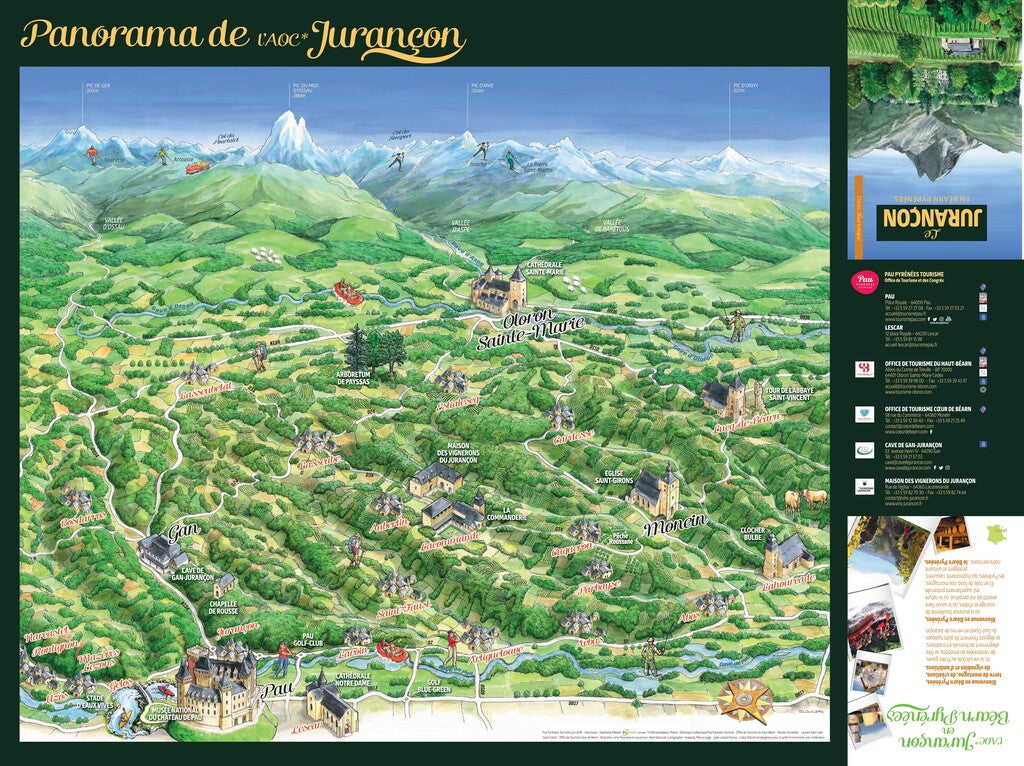
Map provided by the Pau Tourist Office
